Muirkirk and its surroundings
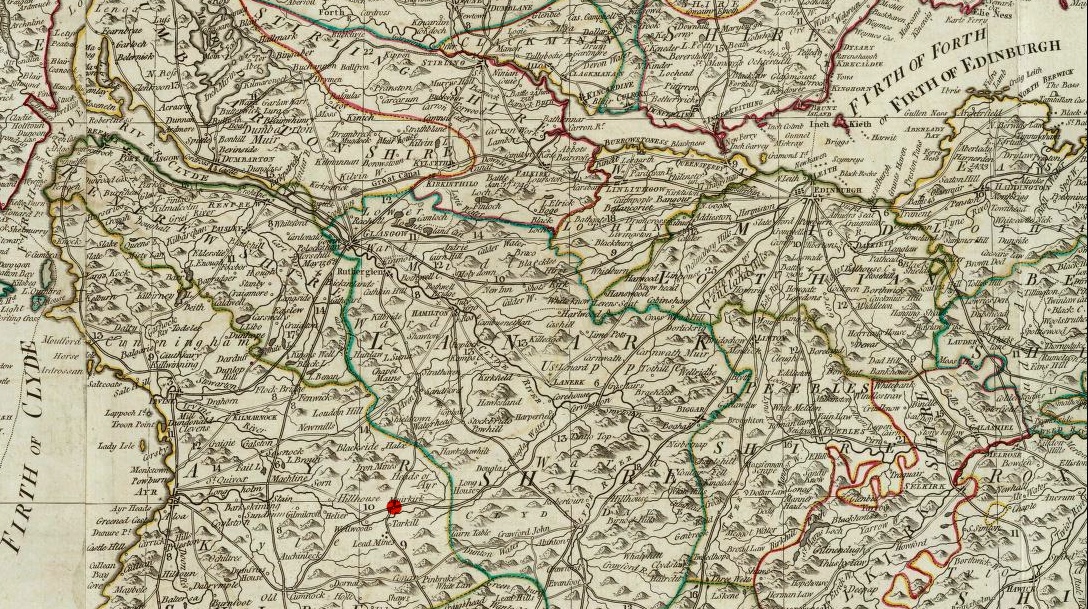
Muirkirk, a small village in East Ayrshire southwest Scotland, was created when the “Kirk of the Muir” was built in 1631.
At that time there was not a single house in the vicinity and the Kirk was described as "a puir wee kirk, theeked wi' heather".
There are a number of different contemporary descriptions as to what it was like to live in Muirkirk in the middle of the 18th Century ranging from an idealised portrayal of rural life to more objective reports commenting on the agricultural economy and state of those living there.
The Fantasy...
The Edinburgh Magazine
A vivid description of life in Muirkirk at that time is set out in The Edinburgh Magazine.
The full article includes much detail concerning the location of Muirkirk, the principal land-owners and the rivers that flow nearby. The following extract gives a flavour of the positive picture painted:
The parish tho' mountainous is exceeding good for pasturage, affording great store of sheep, which is the chief commodity the inhabitants depend on; there are storemasters here whose rooms contain more than ninety scores of old sheep, besides lambs. They have also a great deal of black cattle; some of them will have above thirty milk cows, besides others which they keep in proportion; and each of them as much tallage (a few rooms (farms) excepted) as affords them as much corn and bear, as mostly maintains their families, except it be in time of dearth. The women here are exceeding fine dairymaids, and make a good deal of butter and cheese; the former they mostly use for mixing tar, for the laying of their sheep. I have seen cheeses four stone troy in weight, made of ewe milk there, which they sell at a great price. They scarcely at any time sell any of their cheeses below four shillings per stone at the first hand, and I never eat any in my life more palatable than what this parish afford. Few places can equal them for breeding of horses, of which they have great score. Some of the inhabitants will have twenty, and scarce anyone has below six. They have plenty of moss, which they cut into peats, and dry them in summer-time for fuel. They have also coal and limestone in great plenty in every room or mailing; so that each family, if they please, may dig and find coal and limestone below their house floors.
There is also plenty of free stone there. The thing they mostly want is wood, which is very scarce here. The muirs afford great store of wild fowl such as the heath-cock and heath-hen, partridges, green and grey plover, and a bird with a long beak called a whaap, duck and drake, and hares in great plenty, which makes it a fine place for game in the summer.
There is not a more delightful place in the summer, nor a finer air in all Scotland than here, nor a more industrious frugal people than the inhabitants; there is none in the nation that will take a more hearty bottle when occasions offers than they. There are few or no poor people here, at the most not above three at a time, whom they plentifully maintain by a fund they annually raise; and there is scarce any parish whatever that can say they ever saw any of the inhabitants of the Muir Kirk of Kyle begging; I dare say there is none.
"The Edinburgh Magazine" (1761)
The Reality...
It is difficult to believe that the above description contained in the Edinburgh Magazine was anywhere close to reality having regard to other accounts exist that describe Muirkirk at that time in a very different way:
General view of the agriculture of the county of Ayr
There was hardly a practicable road in the country. The farm houses were mere hovels, moated with clay, having an open hearth or fire-place in the middle; the dunghill at the door; the cattle starving, and the people wretched. The few ditches which existed were ill-constructed and the hedges worse preserved. The land over-run with weeds and rushes gathered into very high, broad, serpentine ridges, interrupted with large baulks such as still disgrace the agriculture of some English counties. The little soil there was, was collected, on the top of the ridge, and the furrow drowned with water. No fallows - no green crops - no sown grass - no carts or wagons - no straw yards: hardly a potato or any esculent root, and indeed, no garden vegetables unless a few scotch kail which, with milk and oatmeal, formed the diet of the people: with little straw, and no hay, except a scanty portion of the worst quality collected from the bogs. The quantity of dung produced was of small avail and that proportion little as it was the farmers dragged on cars or sledges or on what were called tumbler wheels which turned with the axletree and supported the wretched vehicle, hardly able to draw 5 hundredweight. The ground was scourged with a succession of oats after oats, as long as they would pay for seed and labour, and afford a small surplus of oatmeal for the family: and then remained in a state of absolute sterility, or over-run with thistles, till rest again enabled it to reproduce a scanty crop.
The arable farms were generally small, because the tenants had not stock for larger occupations. A plough-gate of land, or as much as could employ four horses, allowing half of it to be ploughed, was a common sized farm. It was often runridge or mixed property; and two or three farmers usually living in the same place, and had their different distributions of the farm, in various proportions, from 10 to 40, 60 or 100 acres.
Many of their leases were for three 19 years. The rent was generally paid in kind, or what was called half-labour by the steel-bow tenants, like them Metayers of France; the stock and implements being furnished mutually, or on such terms as could be fixed. One half of the crop went to the landlord, and the other remained with the tenant to maintain his family and to cultivate his farm. The tenants were harassed with a multitude of vexatious services; such as ploughing and leading for the landlord, working his hay, and other operations, which from the nature of them, unavoidably interfered with the attention necessary on the tenants own farm.
The farm was divided into what was called the croft, or infield, and outfield land. The croft, which commonly was a chosen spot near the house, after two or three crops of oats, received all the dung produced from the farm, and then was sown with big or four-rowed barley. It then remained a year in lay, and was broke up the following year to undergo the same rotation. The starved cattle kept on the farm, were suffered to poach the fields, from the end of harvest, till the ensuing seed time; and thus the roots of natural grass were cut on the clay lands, or drowned with water standing in the cattles footsteps. The horses, during winter, were fed on straw, on boiled chaff or weak corn, and on such hay as the bogs or mashes spontaneously produced.
As the winter seasons, in Ayrshire, are extremely wet, the plough was never yoked till Candlemas. It does not appear that the farmers were in the practice of using more than four horses to each plough, but there was a man to hold, another to drive, and a third to clear the mould board, and keep the couture in the ground. The plough was of the Scotch kind; and as the land was generally stiff and full of stones, and never properly cultivated, it was thought necessary to construct it of the strongest and most clumsy materials… The cold and rainy springs suggested the practice of sowing extremely late, so that oats were seldom harrowed in before April: and it was not unfrequently the end of May, before the big or four-rowed barley was put in the ground.
As there were few or no enclosures, the horses and cattle were either tethered or, during the summer months, or trusted to the direction of a herd or cur dog, by whom the poor starved animals were kept in constant agitation; being impelled, through famine, to fly from their bare lays, and commit continual depredations on the adjacent crops.
The cattle, starved during winter hardly able to rise without aid in spring, and perpetually harassed during summer, were never in fit condition for the market. But undoubtedly they must have been of an admirable race and stamina, otherwise they never could have survived the treatment they experienced.
Very little butcher meat was used, excepting a proportion, which every family salted at Martinmas, to serve during winter, with their grots, or prepared barley, and nail or broth; the rest of their food consituting at that time chiefly of porridge, oatmeal cakes and some milk and cheese.
The state of the markets was in general so low, and public credit so ill established, that no tenant could command money to stock his farm; and few landlords could raise the means of improving their estates. Indeed, when a laird wished to raise money, he was obliged to sell his property, perhaps, for a twenty year purchase, or accept of loans or wadset; the nature of the obligation being, that if the money was not repaid in a specified time, the land became the property of the lender. There were no manufactures in the country, excepting of bonnets at Stewarton, and of shoes and carpets at Kilmarnock. Exports and imports from the harbours of Ayr, Irvine and Saltcoats were on a very small scale indeed. In general the finest lands were let for two or three shillings per acre: and there was neither skill, capital, industry nor credit in the country, to do away the wretchedness described.
The consequences of such mismanagement, were truly deplorable. The people having hardly any substitute for oatmeal, were entirely at the mercy of the season. if the seed-time was unfavourable, the summer bad, or the autumn late or stormy, a dearth or famine unavoidably ensued.. In these seasons of misery, the poor people have not unfrequently been obliged to subsist by bleeding their cattle and missing the blood, so procured, with what oatmeal they could procure.
"General view of the agriculture of the county of Ayr : with observations on the means of its improvement" (1793) by Colonel Fullerton
There are other commentaries such as this one taken from a report to the Agricultural Board published 20 years after Colonel Fullerton's report that also paints a picture of an impoverished population and a subsistence economy:
A Survey of Ayrshire
There were no practicable roads. The farm homes were mere hovels moated with clay, having an open fireplace in the middle, the midden at the door. The cattle starving, and the people wretched. The land, overrun with weeds and rushes, was gathered up into ridges, the soil on the top of the ridge and the furrows drowned in water.
No green crops, no sown grass, no carts or waggons. No garden vegetables except a few Scotch kail which, with milk and oatmeal, formed the diet of the people, with the exception of a little meat salted for the winter. The people, having no substitute for oatmeal, were at the mercy of the seasons. If these were bad, famine ensued. Indeed, after a succession of wet seasons at the end of the 17th and the beginning of the 18th centuries, the people were obliged to subsist on a little oatmeal mixed with blood drawn from their miserable cattle.
Muirkirk, Dalmellington, Dreghorn, Dunlop and Barr are despicable places.
In [the houses] of Muirkirk and Glenbuck a midden or stenching gutter, and frequently both, are found almost before every door. In some of them the whole ashes, and every species of filth, collected by the inmates since the house was erected, remain heaped up before it, so large and so near that scarcely a road is left to the door.
"A Survey of Ayrshire" (1811) by William Aiton of Strathaven
A gradual improvement..
In the second half of the 18th Century it is possible to identify some early initiatives that ultimately resulted in significant improvements in the economic fortunes of Ayrshire - in part as a result of improvements in agricultural productivity but also due to the start of a move away from an economy based purely on agriculture to one where Muirkirk thrived at the forefront of the Industrial Revolution.
Archibald Cochrane, born on January 1st 1748, became the ninth Earl of Dundonald on his father’s death in 1778. He was wealthy, owning property throughout the United Kingdom including substantial lands near Muirkirk where there were significant deposits of coal. Whilst serving on a ship he became aware of the problems arising out of the activities of shipworms boring holes into the wooden hulls of ships and in unfavourable conditions destroying the vessels within a matter of months. In 1780 he discovered a way to extract coal tar from coal at a much lower cost than had previously been possible - making it cost-effective to sell the tar as a coating to protect ships from shipworm and coal was mined from deposits surrounding Muirkirk to manufacture coal tar for this purpose. (In fact this particular initiative was rapidly curtailed, as the use of coal tar to protect ships was superseded by the widespread adoption of copper sheathing, however the development of the coal deposits continued).
The Muirkirk Iron company was formed in 1787 and this, along with coal mining nearby (a coal mine was begun in 1799 which subsequently became known as the Kames Colliery), provided a boost to the local economy and led in turn to the development of a significant iron manufacturing capability in the 19th Century.
From 1750 Muirkirk's population grew at a faster rate than nearly all of Ayrshire and The Statistical Accounts of Scotland 1791-99 recorded the fact that, whilst at some point after 1750 the number of examinable persons in Muirkirk was as low as 447, there had by the 1790s been an increase of 532 men, women and children connected with "the manufactures" and made a point of recording the fact that this innovation was something to be praised:
There are the local and natural advantages of this parish and they are no doubt considerable. But it boasts, of late other advantages, still greater in one respect, because they enhance its natural ones, give them value, and call them forth into effect, I mean the manufactures lately established and which have been already mentioned. The success of these is an object truly desirable. Every friend of his country and of the public must, upon all occasions, wish well to the laudable and useful enterprise. We respect, nay we praise, that man who can improve or enrich the surface of the earth, can mow down rich crops from fields formerly barren, or even double the grains of corn, upon those that bore before. But surely an equal share of praise is justly due to that man, who, in countries that are ungrateful to the labours of cultivation, and either discourage or forbid its useful toil, can drag from the sluggish bosom of the earth, in which they lie concealed, inactive, and useless, those minerals, which under the forming hand of art gradually assume every figure and every shape, and serve at once to accommodate, or adorn life.
"The Statistical Accounts of Scotland 1791-99"
An indication of how dramatic the changes were over the following century - as the full impact of Muirkirk's economy moving from being predominantly agricultural to one that was based on manufacture was felt - is shown here:
The Ordnance Gazetteer of Scotland
The place has undergone great fluctuations of prosperity; but, during the last half century, and especially since the formation of the railway, it has been very flourishing, insomuch as to rank among the great seats of the iron manufacture in Scotland. The works of the Eglinton Iron Company have several blast furnaces and coal-mining and lime-burning are actively carried on.
"The Ordnance Gazetteer of Scotland" (1896) by Francis H Groome - an extract from the entry on Muirkirk
Other material
- The Ayrshire climate - why does it rain so much?
- Nightlife in Ayrshire in 1790 - how the unmarried youth partied...
©John Lapraik www.lapraik.com
The extract from "A new and correct map of Scotland or North Britain (Southern section)" dated 1790 is licensed under a Creative Commons License.