Robert Burns 1759 - 1796
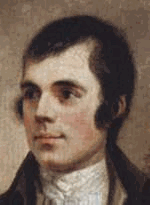 Robert Burns was born in Ayrshire, Scotland in 1759 into a farming family and by the time he was 18 he was working on the family farm at Lochlea.
Following the death of his father in 1784 Burns, then 25 years old, moved to Mossgiel Farm near Mauchline.
Lapraik, living nearby in Muirkirk, was one of a number of local poets who influenced Burns during his early years and the story goes that after hearing one of Lapraik's songs, entitled "When I upon thy bosom lean", he was prompted to write an Epistle to Lapraik.
George Gilfillan describes the circumstances of the delivery of Lapraik's reply:
Lapraik sent a poetical reply to Burns' first letter by the hand of his son, who found the poet in the field sowing. When he gave him the letter, Burns said, "I am not sure if I know the hand;" but when he opened it, he became so engrossed that he let go the sheet holding the grain, and it was half emptied ere he perceived his loss.
"The Life of Robert Burns" (1886) by Rev. George Gilfillan
In response, Burns wrote a Second Epistle (which is regarded as one of his best works) and also subsequently a Third Epistle to Lapraik.
They are known to have met at Mauchline in 1785 and later in the year Burns visited Lapraik and spent the night in Lapraik's home at Muirsmill as his guest.
Burns was nearly 30 years younger than Lapraik, then 58 years old, and would have been well acquainted with Lapraik's financial problems which had culminated in him spending time in gaol for debt only three or so years earlier as a consequence of the collapse of the Ayr Bank.
The two of them remained friends and it is believed that Lapraik was Burns' model in his famous poem, "A Man's a Man for a' That".
Burns had struggled as a farmer but in 1786, aged 27, he had a book of his poems published by John Wilson, a printer in Kilmarnock, Ayrshire. The success of this first "Kilmarnock edition" (all 612 copies of the book were sold within a month) changed the course of his life.
In 1796 Burns died ten years later - aged only 37 - but had by then secured his place in history as Scotland's greatest poet.
All of the Epistles and other writings linking the two men are brought together on a single page.